

Dear Editors of the Journal of Performing Arts Medicine,
This letter does not arise from the reading of a paper, as is usually the case.1 However, it is strictly related to our shared field of interest: performing arts medicine and, more specifically, performing arts physiotherapy.
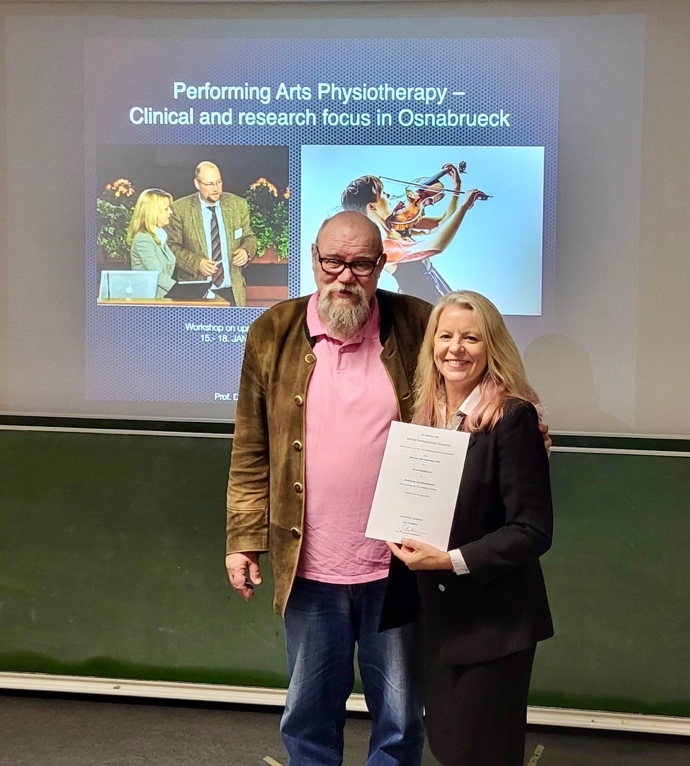
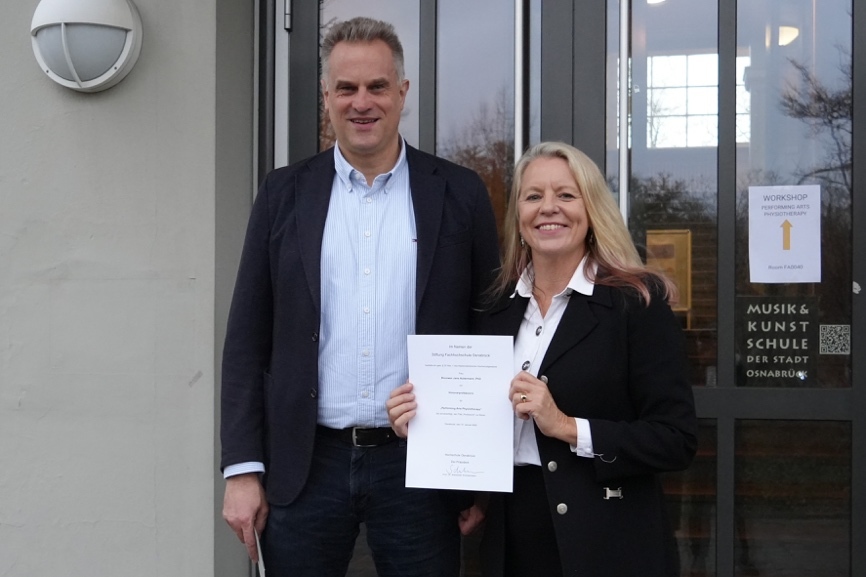
Following the recent launch of your journal, we would like to share some exciting news about our field with our global community: Bronwen Ackermann has recently been appointed the world’s first Professor of Performing Arts Physiotherapy, which is a positive sign that this discipline is gaining academic credibility. This is probably in response to the growing number of healthcare practitioners embracing this speciality across the globe.
_and_prof._mult._dr._bronwen_ackermann.jpeg)
_and_prof._mult._dr._bronwen_ackermann_.jpeg)
The creation of this position and the appointment of Bronwen Ackermann, whose extensive list of publications, conferences and lectures in various countries and institutions speaks for itself, at the University of Applied Sciences in Osnabrück, Germany (a country with a long musical tradition), is clear evidence that European physiotherapists, both clinicians and researchers, are now joining their counterparts in other Western countries to promote the official recognition of our field of expertise.
We will not discuss the high prevalence of injuries among performing artists and the various health conditions they may experience here, as we are all aware of the severity of the situation. However, we would like to highlight how physiotherapy can help with many pathologies, including a large proportion of musculoskeletal conditions, as described in the systematic review by Rotter et al. (2020), as well as neurological conditions such as focal dystonia.2 For example, physiotherapists have demonstrated their ability to treat musicians in specialised clinics3 and perform triage in orchestral settings.4 They have even been mentioned as a potential member of touring teams5 and as someone who visits hotels and venues during tours.6
In relation to the topic of physiotherapy for performing artists, Bronwen Ackermann has been appointed to two professorships in Sydney: one in Physiotherapy and one in Functional Anatomy. She was asked how she manages these three roles on two different continents:
“I think that functional anatomy underpins what we do as physiotherapists, so I always consider the anatomy, physiology and biomechanics of the tasks that the body is undertaking when assessing and managing injuries. Australia is internationally regarded as one of the world leaders in physiotherapy education, and so I will be bringing the highest quality of training into Germany. In turn, the formal recognition by the Deutsche Forschungsgemeinschaft and the University of Applied Sciences in Osnabrück of the importance of this field is bringing Germany into the position of world leaders of education in this specific topic.”
This entitlement is directly related to two initiatives funded by the DFG at the University of Applied Sciences in Osnabrück. The first initiative aims to further develop the discipline of Performing Arts Physiotherapy (PAP) by developing a new curriculum focusing on three key areas: evidence-based performing arts physiotherapy, clinical practice in this field and patient-specific factors such as culture, society and the environment. Bronwen Ackermann reports:
“As an educator, research and clinical physiotherapist, I bring 3 decades of experience and academic skills to design a curriculum for the Master’s Program in Performing Arts Physiotherapy with the Osnabrück team. To ensure the very highest quality, research evidence is underpinning much of the content and approaches, and in this regard, I have extensive experience in conducting research into preventing and managing injuries in musicians and the translating this into clinical practices as well as within music settings. For decades, I have been stressing the importance of a systematic and scientific approach to physiotherapy management of neuromusculoskeletal problems in this population. However, without the support of a proper curriculum where the information can be presented in a progressive manner that is very specifically applied to performing arts populations, information that has been presented to date has been ad hoc and incomplete. Osnabrück has developed a team of physiotherapists with an impressive blend of necessary and relevant experience in clinical, epidemiological and biomechanical aspects of human performance, and have additionally been working with performing artists for many years now. This breadth of complementary experience is quite unique and their passion for really advancing the scope of physiotherapy in Germany makes them a great team to collaborate with.”
Secondly, the European Network of Physiotherapy for Performing Artists was recently established in April 2026. Its purpose is to promote science and research in physiotherapy for performing artists, integrate research findings into practice and establish the new subdiscipline of Performing Arts Physiotherapy. It will do this by building a strong professional network for physiotherapists, physiotherapy students, trainees and individuals involved in physiotherapy education or research.

Ethical approval
None needed.
Sources of funding
The author(s) declared that financial support was received for the conceptualisation and the writing of this letter: Deutsche Forschungsgemeinschaft (DFG) – Grant number: FIP700/1-2024. Project number: 529490002.
Authors contribution
Céleste Rousseau wrote this letter to the editor on request of Christoff Zalpour who interviewed Bronwen Ackermann about her entitlement at the University of Applied Sciences in Osnabrück as Professor for Performing Arts Physiotherapy.
Conflict of interest disclosures
Bronwen Ackermann, Céleste Rousseau and Christoff Zalpour are close collaborators in the DFG-project PA.H|lifetime (www.hs-osnabrueck.de/en/pahlifetimeai/) which is about to establish and systematically embed the new subdiscipline Performing Arts Physiotherapy.